

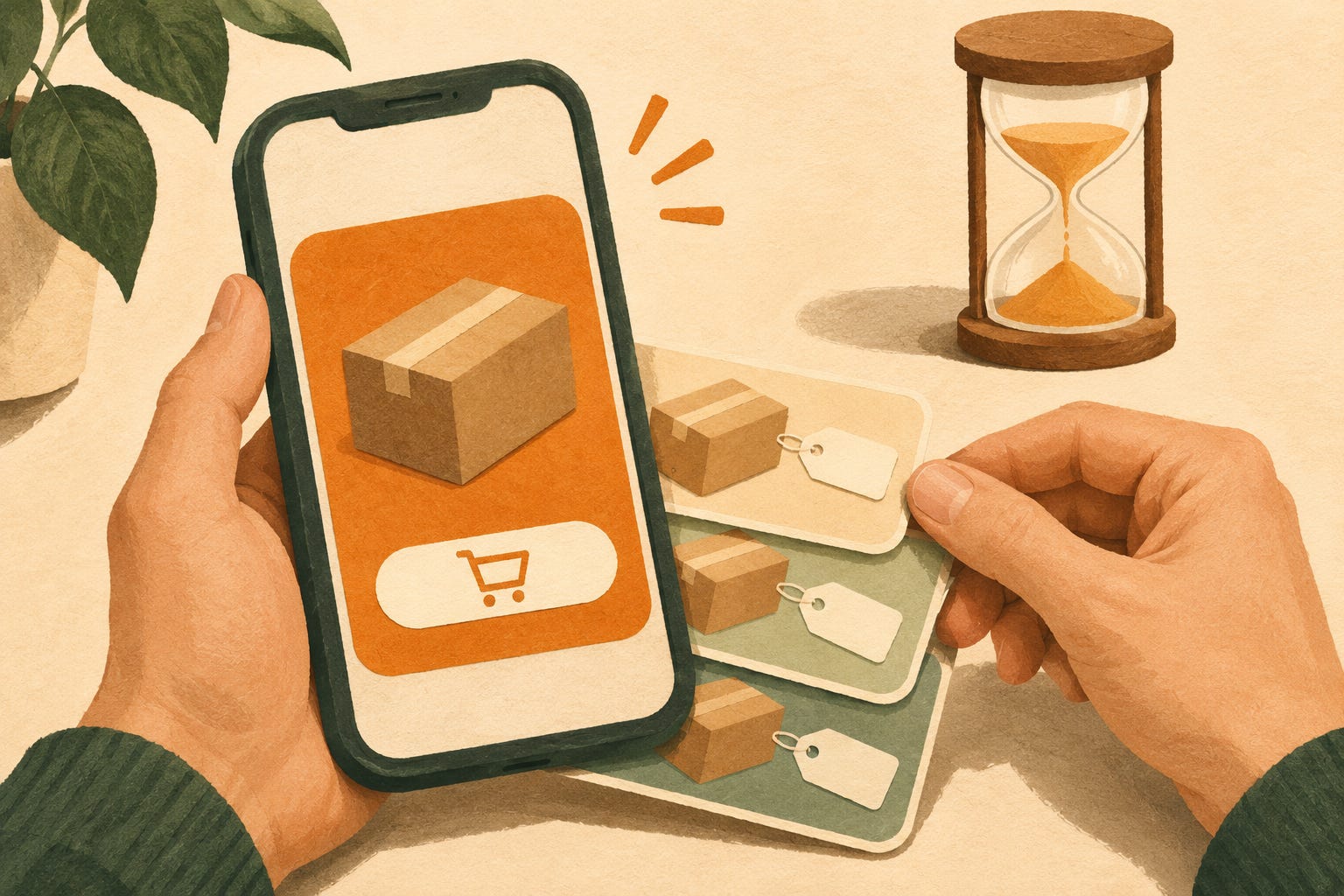
If you’re in a hurry, don’t know the alternatives or don’t have time to look, a company can end up with a captive audience. You might accept a price because finding a better deal takes time you don’t have. I understand paying more for convenience, but what feels unethical to me is a company using that moment to work out how much more it can charge you.
AI could make that problem worse. It can help us find what we want and buy it with less effort, which is useful when we’re short on time. But as those experiences become more responsive to us, I want to know whether the same effort is going into helping us compare the deal. If someone is building AI to make buying easier, I’d also like someone building it to help the consumer push back.
AI is changing our lives. Subscribe to The Human Part to explore what that means for people.
Getting what you need can still feel like a bad deal
Looking at this through a consumer psychology lens, Richard Thaler’s idea of transaction utility helps explain why getting something you need doesn’t always leave you feeling good about the purchase. Alongside the value of the product itself, you judge the deal against a reference price: what you expected to pay, or thought was reasonable. You may be willing to pay the price in front of you and still feel taken advantage of, especially if the alternative is spending more time searching.
A 2026 study by Giulia Priolo and colleagues revisited seven mental-accounting scenarios, including 5,589 people across 21 countries. The selected effects replicated in the pooled analysis, though there were differences between countries. The 2022 survey asked about hypothetical choices, not AI purchases, but it gives us a reason to keep examining the psychology behind the deal.
Why the price goes up matters
In a 1986 study by Daniel Kahneman, Jack Knetsch and Richard Thaler, 82% of 107 respondents judged it unfair for a hardware store to raise a snow shovel’s price from $15 to $20 after a snowstorm. This was a hypothetical question in a Canadian telephone survey, not a record of what people bought. The researchers’ idea of dual entitlement recognizes expectations on both sides: customers expect familiar terms, while businesses are seen as entitled to protect their reference profit. In those surveys, people treated covering higher costs differently from taking advantage of increased demand.
That distinction gets at my concern. Paying for delivery or speed can make sense. A company inferring that I’m stuck and then adjusting its price around that moment feels different. AI could give businesses more ways to respond to customer information, though whether it produces an individual markup in a particular case needs evidence.
What companies are already doing with prices
Amazon describes seller tools that adjust prices according to competing offers or sales. Delta gives us a more specific AI example. In a letter sent September 9, 2026, the airline described a pilot using generative AI fare recommendations to help analysts respond faster to changing market conditions. Delta says the tool receives route-level demand and market data, not customers’ personal information. That supports AI-assisted dynamic pricing; it doesn’t establish that the airline spots an individual traveler in a hurry and raises their fare.
Instacart provides a different example. A December 2025 investigation by Consumer Reports, Groundwork Collaborative and More Perfect Union found shoppers being shown different prices for identical groceries from the same store at the same time. In one test, an 18-ounce box of corn flakes appeared at $2.99, $3.49 and $3.69. These were displayed cart prices, not completed purchases. Instacart said the differences came from randomized A/B tests using its Eversight technology, not personal-data targeting or real-time demand. On December 22, 2025, it announced the end of those item-price tests. It is a documented historical case, not a claim that those tests are still running.
Those are different mechanisms, but both bring us back to the shopper trying to judge the offer. A price can respond to a market, or a retailer can test different prices, without proving that a system knows a particular person is stuck. A higher flight price on a return visit doesn’t isolate the cause either; Skyscanner says repeat searches don’t increase prices on its service. That is the company’s account, not an audit of every booking site.
Walmart’s agent announcement is a useful boundary. In its October 21, 2026 statement, Walmart says an AI agent sees the same product prices as a person on Walmart.com. That is the company’s stated policy, not an independent test, but it doesn’t support saying its shopping agent charges an individual more. A shopping assistant and the system setting a price are not necessarily the same thing.
The FTC has also sought information from nine companies about personal data in pricing and, where relevant, worker compensation. An inquiry is not a finding of wrongdoing.
Put AI to work on the comparison
There is already a reason to look beyond the first convenient offer. OpenAI’s shopping guidance says the initial price commonly comes from the first merchant listed and may not be the lowest; more merchant options can appear when you select the product. That doesn’t prove personalized overcharging, but it does mean the first price you see may not be the best one available.
If an AI assistant were working on my side, I’d want it comparing prices across sites, checking for consistency and looking for the lowest price it can find. It would need to compare the same thing, including relevant fees and delivery terms, and tell me when it can’t verify a price. I want the convenience, but I also want the comparison happening before I’m asked to buy. Being in a hurry shouldn’t have to mean becoming a captive audience.
Prepared with AI assistance from my interview answers.
Dr. James Kelley
drjameskelley.com
Get The Crucible’s Gift on Amazon
Check your AI fluency
If this gave you something to think about, I’d love to have you back. Subscribe for more on AI and the human part of our lives.
Sources
Thaler, Mental Accounting and Consumer Choice, 1985. Transaction utility and reference prices; not an AI study.
Priolo et al., The Robustness of Mental Accounting Across 21 Countries, 2026. Selected hypothetical scenarios using 2022 survey data; not AI purchases.
Kahneman, Knetsch and Thaler, Fairness as a Constraint on Profit Seeking, 1986. Hypothetical fairness judgments in Canadian telephone surveys.
Amazon, Automate Pricing. Seller-tool documentation, not evidence of shopper targeting.
Skyscanner, Do browser cookies increase flight prices?. The company’s explanation of its service, not an industry-wide audit.
FTC, Personalized Pricing and Compensation Inquiry, October 28, 2026. An information-gathering inquiry, not a finding of wrongdoing.
OpenAI, Shopping with ChatGPT Search. The company’s explanation of displayed prices and merchant options, not a lowest-price guarantee.
Delta, September 9 letter on AI-assisted pricing, published September 18, 2026. Company account of an analyst-support pilot and its denial of personal-data fare targeting.
Groundwork Collaborative, Consumer Reports and More Perfect Union, Same Cart, Different Price, December 9, 2025. Historical displayed-price investigation; no completed purchases.
Instacart, The Truth About Pricing Tests, December 18, 2025. Company response distinguishing randomized A/B experiments from dynamic or personal-data pricing.
Instacart, Ending Item Price Tests, December 22, 2025. Company announcement ending those experiments.
Walmart, Agents shopping on behalf of customers, October 21, 2026. Company statement that agents see the same product prices as people.